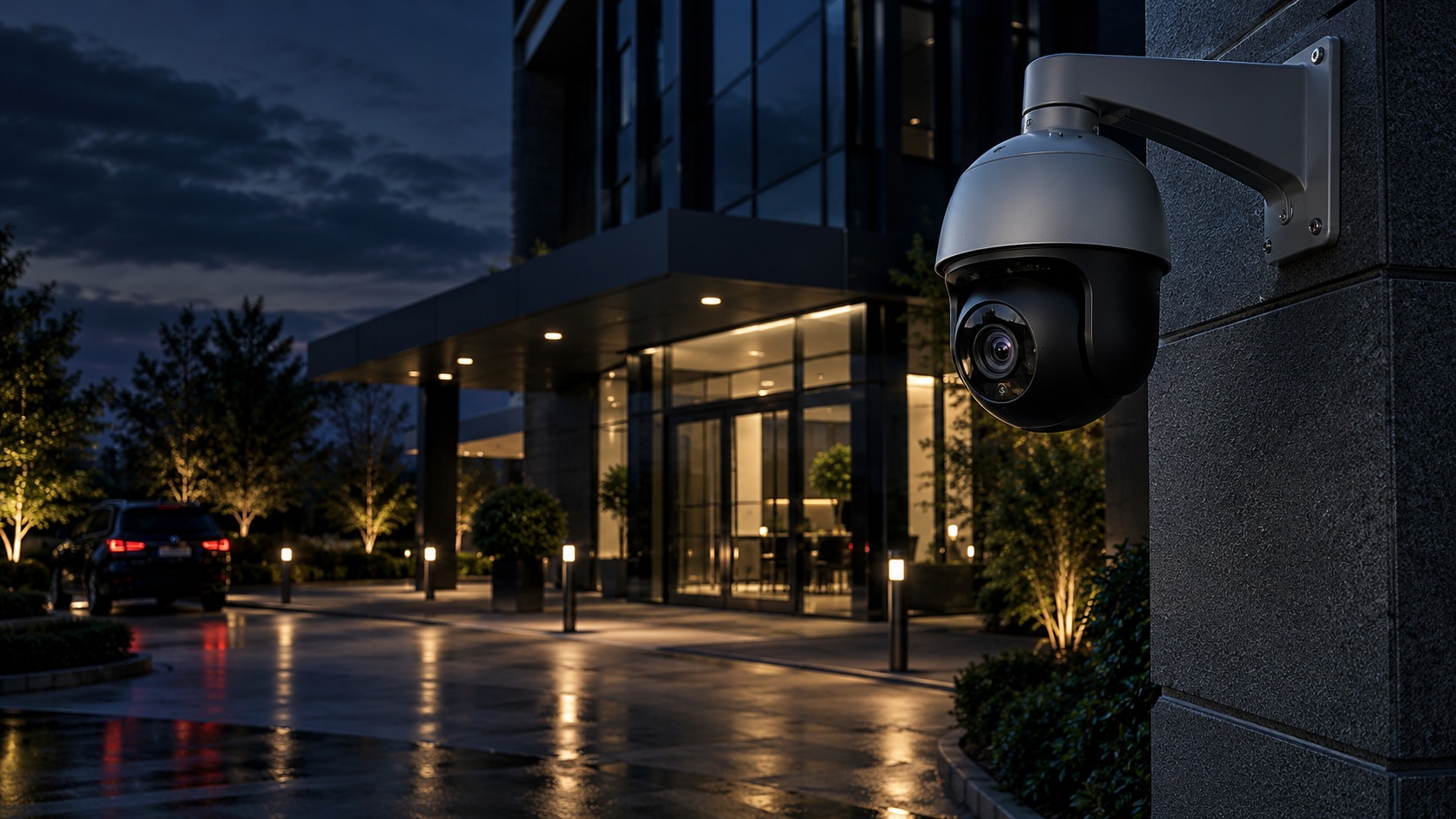
Most security cameras stare at one fixed scene. A PTZ camera moves. Pan, tilt, and zoom, the three motions the letters stand for, let a single PTZ camera sweep across a wide area, follow activity, and zoom in for detail that a fixed camera cannot capture. For the right Connecticut property, one well-placed PTZ camera covers ground that would take several fixed cameras. Mammoth Security Inc. designs camera systems that use PTZ cameras where they earn their place, with teams working from the Norwalk office on Westport Avenue and the New Britain office on Hartford Square.
A PTZ camera is a motorized camera that an operator or an automated rule can aim in any direction and zoom in or out on demand. Where a fixed dome or bullet camera watches one framed scene, a PTZ camera rotates a full circle, tilts up and down, and uses optical zoom, meaning true lens magnification rather than the pixelated digital enlargement that ruins detail, to read a face or a plate across a large space. That range of motion is the whole point, and it makes PTZ cameras a specific tool for specific jobs rather than a default choice for every wall.

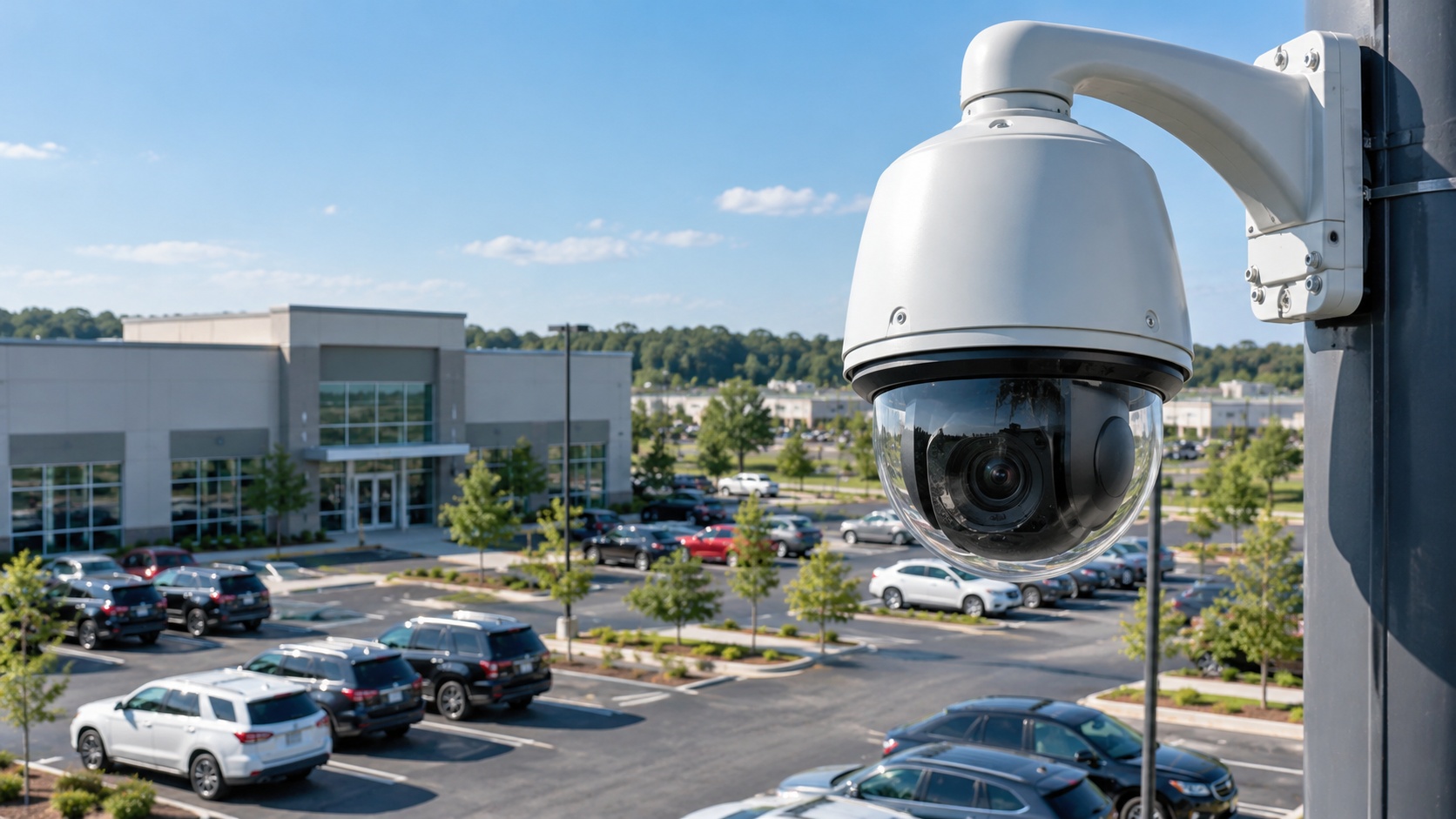
PTZ cameras belong on large, open areas where activity moves and detail matters at distance. A parking lot or parking structure, a building perimeter, a large yard, a storage or equipment area, a loading dock, or a wide plaza are the scenes a PTZ camera covers well, sweeping the space and zooming in when something needs a closer look. On a Connecticut industrial site or a large multi-family property, a PTZ camera at a high vantage point watches a broad area that would otherwise need a row of fixed cameras, and it delivers zoomed detail no fixed camera at that distance could.
The trade-off is that a PTZ camera looks in one direction at a time. While it is zoomed in on one corner of a lot, it is not watching the rest. This is why PTZ cameras work best alongside fixed cameras, not instead of them. Fixed cameras provide the constant, complete coverage of a scene, recording everything all the time, while the PTZ camera adds the reach to zoom in on detail and follow activity. A well-designed Connecticut system uses each for what it does best, and Mammoth Security specifies the mix rather than selling motion for its own sake.
Modern PTZ cameras do more than wait for an operator to steer them. Auto-tracking lets a PTZ camera lock onto a moving person or vehicle and follow it across the camera's range automatically, keeping the subject in frame without anyone at a joystick. Preset positions let the camera patrol a set route, moving between defined points on a schedule so a wide area gets regular coverage. Tied into video analytics, a PTZ camera can swing to a preset when a fixed camera or a sensor detects activity in a zone, putting the zoom lens on an event the moment it starts. These features turn a PTZ camera from a manually driven tool into an active part of a monitored system.
PTZ cameras vary in the specifications that decide whether they perform. Optical zoom range determines how far the camera can read detail. Resolution, up to 4K, sets how much detail the image holds. Low-light and infrared performance decides whether the camera is useful at night, when much of the activity that matters happens. Weatherproof and impact-resistant housings matter for the outdoor mounts where PTZ cameras usually live, holding up through coastal weather near Norwalk and hard winters near New Britain. Mammoth Security specifies these to the site, matching the zoom, resolution, and night performance to the distances and lighting the camera actually faces.
Brand matters for the analytics and reliability that separate a professional PTZ camera from a consumer one. Mammoth Security works with premium and NDAA-compliant lines, Avigilon, Axis, and Hanwha Vision among them, that deliver the auto-tracking, integration, and durability a commercial site needs. For a Connecticut facility that takes federal or state funding or serves aerospace and defense-adjacent work, NDAA-compliant cameras are required rather than optional, a distinction Mammoth Security raises before hardware is chosen.
A PTZ camera reaches its potential as part of an integrated system, not as a standalone device. Connected to a video management system such as the Avigilon Control Center, ExacqVision, or Milestone, a PTZ camera's feed records alongside the fixed cameras, its presets tie into analytics and alarms, and an operator controls it from the same interface that runs the whole system. That integration is what lets a PTZ camera swing to an event a sensor detects, or lets an operator following a person on a fixed camera hand off to the PTZ for a closer look. Mammoth Security's in-house W-2 technicians handle that integration and the programming behind it.
Mammoth Security is a licensed Connecticut security and low-voltage contractor with four Connecticut locations and more than 5,000 buildings secured across the state. Its technicians design camera systems that place PTZ cameras where they add reach and fixed cameras where constant coverage matters, then install, program, and service the whole system in house rather than through subcontractors. Facilities across Fairfield County near Norwalk and central Connecticut near New Britain get the same design discipline.
The value of a PTZ camera shows up clearest in specific settings. On a large multi-family residential property, a common Connecticut client for Mammoth Security, a PTZ camera at a high vantage covers a parking area, a courtyard, or a long building elevation, sweeping the space and zooming in on a specific vehicle or person when a manager or a monitoring operator needs a closer look. On an industrial or manufacturing site, a PTZ camera watches a yard, a loading area, or an equipment lot, following a truck through a gate or reading a trailer number at distance. On a large commercial or municipal property, a PTZ camera covers a plaza, an entrance drive, or a perimeter that a fixed camera could only watch in pieces.
In each case the PTZ camera does a job the site would otherwise solve with several fixed cameras and still lack the zoom. That coverage efficiency is real, but it depends on placement. A PTZ camera mounted at the wrong height or angle, or asked to cover a scene better served by fixed cameras, wastes its capability. The design work of deciding where a PTZ camera belongs, and where a fixed camera is the better tool, is what separates a system that performs from one that merely has an expensive camera on it.
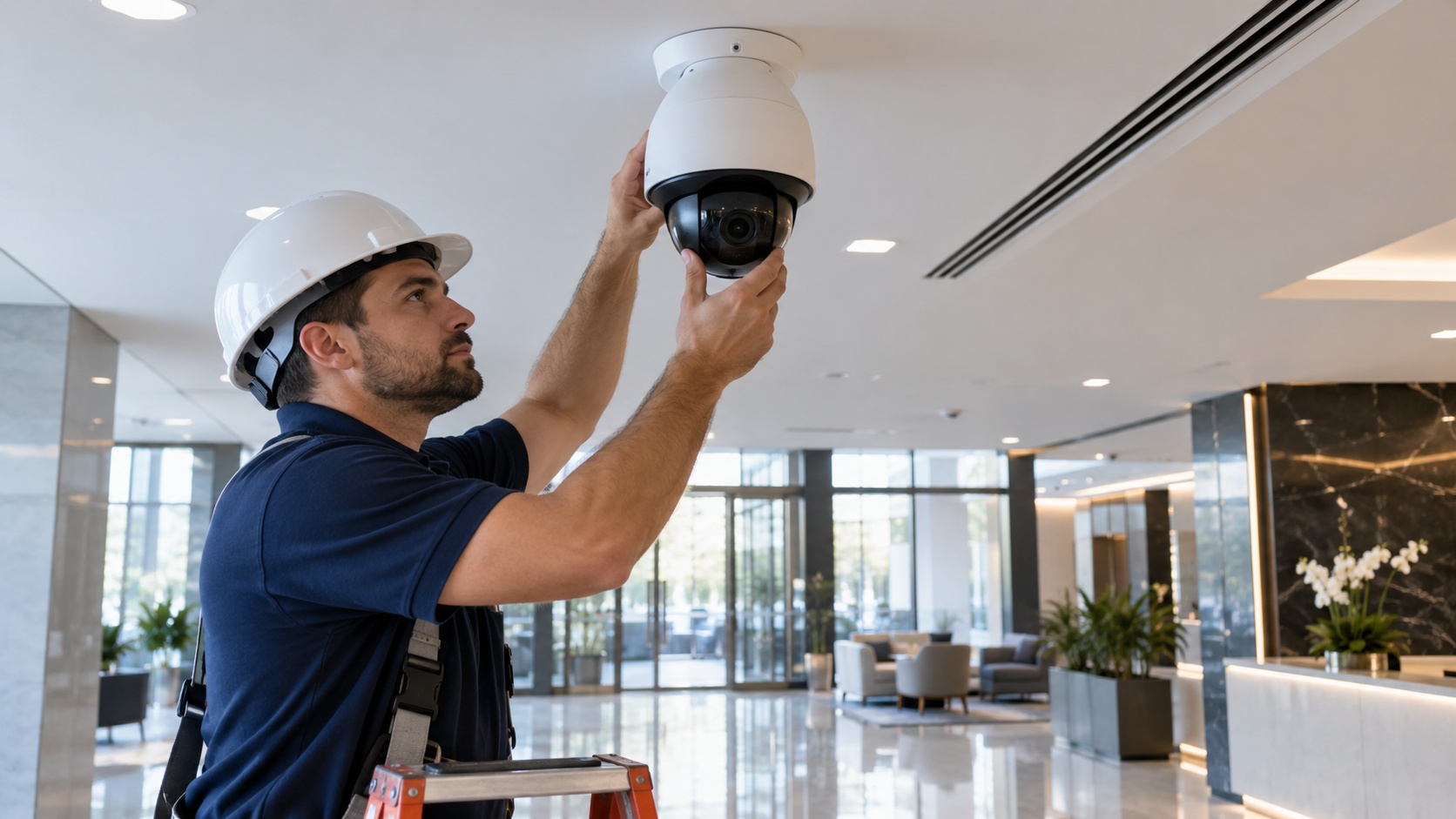
A PTZ camera is most powerful when someone, or something, can drive it in real time. In a monitored setup, a central station operator can take manual control of a PTZ camera during an active event, steering and zooming to follow a situation and gather detail as it unfolds, then feed that information to responders. Paired with the audio and lighting deterrents Mammoth Security installs on many sites, a monitoring operator watching through a PTZ camera can address an intruder and follow them at the same time. For a Connecticut property that pairs cameras with 24/7 monitoring, a PTZ camera turns the monitoring center into an active set of eyes rather than a passive recorder, which is the difference between watching an incident and shaping its outcome.
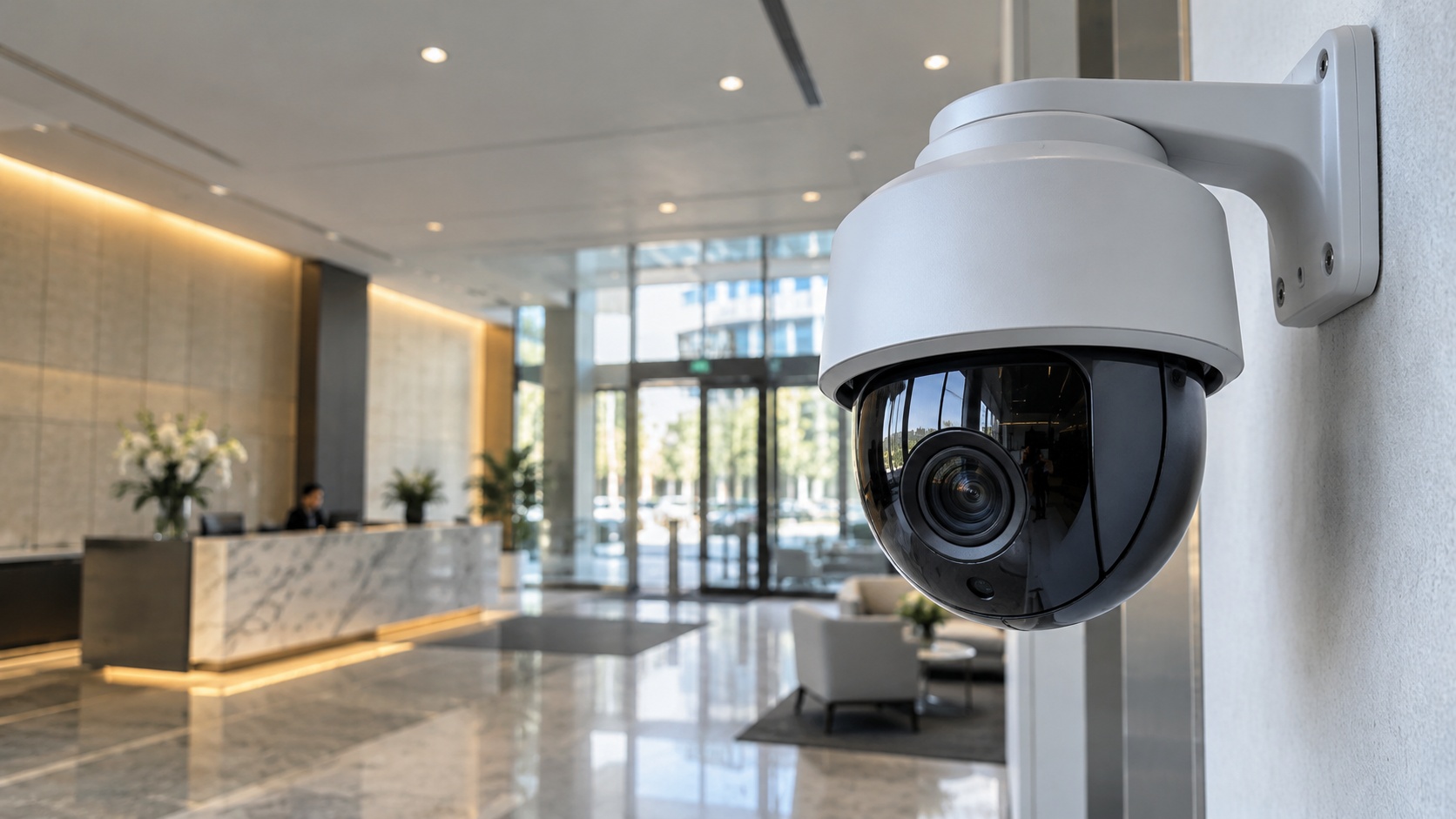
A PTZ camera is a tool, not a whole security system, and the best Connecticut deployments treat it that way. Fixed dome, bullet, and turret cameras provide the constant, complete coverage that records every scene all the time. Access control decides who enters. Alarms and monitoring cover the building when it is empty. The PTZ camera adds reach and zoom to that foundation, covering the large open areas and delivering the detail at distance that fixed cameras cannot. Designed together as one system by one team, these pieces cover a property completely, with each doing what it does best. That whole-system design, rather than a shopping list of cameras, is what Mammoth Security brings to a Connecticut property, from a large multi-family community near Norwalk to an industrial operation near New Britain.
The Connecticut properties that get the most from PTZ cameras are the ones that place them by design, at the right height, over the right open areas, integrated into a monitored system, and paired with the fixed cameras that never look away. Placed that way, one PTZ camera does the work of several and adds a reach no fixed camera can match.
For a Connecticut property with large areas to cover and detail to capture at distance, the starting point is a free on-site assessment that looks at the site, the distances, and the lighting. To plan PTZ security camera installation in Connecticut, contact Mammoth Security Inc. at (860) 854-3446 for a no-obligation written quote.
|
Norwalk, Connecticut
|
|
|---|---|

Flag

Seal

Logo
|
|
| Etymology: Mohegan-Pequot language | |
| Nickname:
Oyster Town
|
|
| Motto:
Latin: E Pluribus Unum
|
|
  |
|
   |
|
| Coordinates: 41°05′38″N 73°25′11″W / 41.09389°N 73.41972°W | |
| Country |  United States |
| U.S. state |  Connecticut |
| County | Fairfield |
| Region | Western CT |
| Settled | February 26, 1640 |
| Incorporated | September 11, 1651 |
| Consolidated | June 6, 1913 |
| Founder | Roger Ludlow and Daniel Patrick[1] |
| Government
|
|
| • Type | Weak mayor–council |
| • Mayor | Barbara Smyth (D) |
| Area | |
|
• Total
|
36.37 sq mi (94.20 km2) |
| • Land | 22.89 sq mi (59.28 km2) |
| • Water | 13.49 sq mi (34.93 km2) |
| Elevation
|
43 ft (13 m) |
| Population | |
|
• Total
|
91,184 |
|
• Estimate
(2024)[4]
|
93,567 |
| • Density | 3,983.90/sq mi (1,538.192/km2) |
| Time zone | UTC−5 (Eastern Standard Time (EST)) |
| • Summer (DST) | UTC−4 (Eastern Daylight Time (EDT)) |
| ZIP Codes |
06850–06860
|
| Area codes | 203/475 |
| FIPS code | 09-55990 |
| GNIS feature ID | 0209405 |
| Major highways |     |
| Commuter rail |  |
| Website | norwalkct |
Norwalk is a city in Fairfield County, Connecticut, United States. The city, part of the New York Metropolitan Area, is the sixth-most populous city in Connecticut as of the 2020 census, with a population of 91,184.[5]. The city is part of the Western Connecticut Planning Region.
Norwalk is on the northern shore of Long Island Sound and was first settled in 1649.
Roger Ludlow purchased the areas east of the Norwalk River from Chief Mahackemo of the Norwaake (or Naramauke) Indians in 1640.[6] Norwalk was settled in 1649, incorporated September 1651, and named after the Algonquin word noyank, meaning "point of land", or more probably from the Native American name "Naramauke".[7]
The Battle of Norwalk took place during the Revolutionary War,[8] and led to the burning of most of the town.[9] In 1836, the borough of Norwalk was created, covering the central area of the town.[10] In 1853, the first ever train disaster in the United States happened over the Norwalk River.[11] During the 19th and early 20th century, Norwalk was a major railroad stop for the New York, New Haven, and Hartford Railroad.[12] The city of South Norwalk and the remaining parts of the town of Norwalk were both combined in 1910 to form the current city.[13]
The Ku Klux Klan had a brief presence in Norwalk during the 1920s, but quickly fell apart due to internal issues.[14] In 1955, multiple hurricanes hit the city, causing flooding in Norwalk Harbor.[15] During the 1970s, efforts were taken to historically preserve South Norwalk, resulting in the creation of the Washington Street Historic District.[16]
According to the United States Census Bureau, the city has a total area of 36.3 square miles (94 km2), of which 13.5 square miles (35 km2) (37.24%) are covered by water.
| Climate data for Norwalk, Connecticut | |||||||||||||
|---|---|---|---|---|---|---|---|---|---|---|---|---|---|
| Month | Jan | Feb | Mar | Apr | May | Jun | Jul | Aug | Sep | Oct | Nov | Dec | Year |
| Record high °F (°C) | 68 (20) |
71 (22) |
79 (26) |
95 (35) |
97 (36) |
97 (36) |
103 (39) |
97 (36) |
99 (37) |
89 (32) |
77 (25) |
66 (19) |
103 (39) |
| Mean daily maximum °F (°C) | 37 (3) |
39 (4) |
48 (9) |
60 (16) |
70 (21) |
79 (26) |
84 (29) |
82 (28) |
75 (24) |
64 (18) |
52 (11) |
42 (6) |
61 (16) |
| Daily mean °F (°C) | 28 (−2) |
31 (−1) |
40 (4) |
50 (10) |
60 (16) |
69 (21) |
74 (23) |
72 (22) |
64 (18) |
53 (12) |
43 (6) |
34 (1) |
52 (11) |
| Mean daily minimum °F (°C) | 19 (−7) |
21 (−6) |
29 (−2) |
38 (3) |
44 (7) |
57 (14) |
62 (17) |
61 (16) |
53 (12) |
40 (4) |
33 (1) |
24 (−4) |
40 (5) |
| Record low °F (°C) | −15 (−26) |
−7 (−22) |
−2 (−19) |
17 (−8) |
30 (−1) |
34 (1) |
45 (7) |
41 (5) |
31 (−1) |
17 (−8) |
14 (−10) |
−9 (−23) |
−15 (−26) |
| Average precipitation inches (mm) | 4.2 (110) |
3.15 (80) |
4.33 (110) |
4.37 (111) |
4.36 (111) |
3.94 (100) |
3.83 (97) |
3.89 (99) |
4.54 (115) |
3.89 (99) |
4.04 (103) |
3.96 (101) |
48.5 (1,236) |
| Average snowfall inches (cm) | 9.3 (24) |
8.3 (21) |
4.9 (12) |
.8 (2.0) |
0 (0) |
0 (0) |
0 (0) |
0 (0) |
0 (0) |
0 (0) |
.7 (1.8) |
4.6 (12) |
28.6 (72.8) |
| Average precipitation days | 10.5 | 9.7 | 10.9 | 12.5 | 12.5 | 11.7 | 10.2 | 9.7 | 9.8 | 9.2 | 10.6 | 11.3 | 128.6 |
| Average snowy days | 4.8 | 4.3 | 2.5 | .4 | 0 | 0 | 0 | 0 | 0 | 0 | .4 | 2.7 | 15.1 |
| Source 1: NCDC[19] | |||||||||||||
| Source 2: The Weather Channel[20] | |||||||||||||
Norwalk's topography is dominated by its coastline along Long Island Sound, the Norwalk River and its eastern and western banks, and the Norwalk Islands.[21] The highest elevation is 315 feet (96 m) above sea level on the fairway of the 16th hole of the Silvermine Golf Course,[22] and the low elevation is sea level on Long Island Sound.
| Census | Pop. | Note | %± |
|---|---|---|---|
| 1790 | 11,942 | — | |
| 1800 | 5,146 | −56.9% | |
| 1810 | 2,983 | −42.0% | |
| 1820 | 3,004 | 0.7% | |
| 1830 | 3,972 | 32.2% | |
| 1840 | 3,863 | −2.7% | |
| 1850 | 4,651 | 20.4% | |
| 1860 | 7,582 | 63.0% | |
| 1870 | 12,119 | 59.8% | |
| 1880 | 13,956 | 15.2% | |
| 1890 | 17,747 | 27.2% | |
| 1900 | 19,932 | 12.3% | |
| 1910 | 24,211 | 21.5% | |
| 1920 | 27,743 | 14.6% | |
| 1930 | 36,019 | 29.8% | |
| 1940 | 39,849 | 10.6% | |
| 1950 | 49,460 | 24.1% | |
| 1960 | 67,775 | 37.0% | |
| 1970 | 79,288 | 17.0% | |
| 1980 | 77,767 | −1.9% | |
| 1990 | 78,331 | 0.7% | |
| 2000 | 82,951 | 5.9% | |
| 2010 | 85,603 | 3.2% | |
| 2020 | 91,184 | 6.5% | |
| 1790 population included Stamford and Greenwich. [23] |
|||
| Race / Ethnicity (NH = Non-Hispanic) | Pop 2000[24] | Pop 2010[25] | Pop 2020[26] | % 2000 | % 2010 | % 2020 |
|---|---|---|---|---|---|---|
| White alone (NH) | 53,324 | 47,718 | 44,314 | 64.28% | 55.74% | 48.60% |
| Black or African American alone (NH) | 12,231 | 11,472 | 11,074 | 14.74% | 13.40% | 12.14% |
| Native American or Alaska Native alone (NH) | 95 | 94 | 102 | 0.11% | 0.11% | 0.11% |
| Asian alone (NH) | 2,672 | 4,045 | 4,772 | 3.22% | 4.73% | 5.23% |
| Pacific Islander alone (NH) | 28 | 25 | 14 | 0.03% | 0.03% | 0.02% |
| Some Other Race alone (NH) | 137 | 244 | 652 | 0.17% | 0.29% | 0.72% |
| Mixed Race or Multi-Racial (NH) | 1,498 | 1,235 | 2,627 | 1.81% | 1.44% | 2.88% |
| Hispanic or Latino (any race) | 12,966 | 20,770 | 27,629 | 15.63% | 24.26% | 30.30% |
| Total | 82,951 | 85,603 | 91,184 | 100.00% | 100.00% | 100.00% |
As of the 2020 census, Norwalk had a population of 91,184. The median age was 39.5 years. 20.3% of residents were under the age of 18 and 16.0% of residents were 65 years of age or older. For every 100 females there were 94.9 males, and for every 100 females age 18 and over there were 92.6 males age 18 and over.[27][28]
100.0% of residents lived in urban areas, while 0.0% lived in rural areas.[29]
There were 36,078 households in Norwalk, of which 29.2% had children under the age of 18 living in them. Of all households, 43.5% were married-couple households, 18.7% were households with a male householder and no spouse or partner present, and 30.5% were households with a female householder and no spouse or partner present. About 29.6% of all households were made up of individuals and 11.0% had someone living alone who was 65 years of age or older.[27]
There were 38,152 housing units, of which 5.4% were vacant. The homeowner vacancy rate was 1.1% and the rental vacancy rate was 5.7%.[27]
| Race | Number | Percent |
|---|---|---|
| White | 48,225 | 52.9% |
| Black or African American | 11,659 | 12.8% |
| American Indian and Alaska Native | 660 | 0.7% |
| Asian | 4,830 | 5.3% |
| Native Hawaiian and Other Pacific Islander | 18 | 0.0% |
| Some other race | 14,350 | 15.7% |
| Two or more races | 11,442 | 12.5% |
| Hispanic or Latino (of any race) | 27,629 | 30.3% |
As of the census of 2010, 85,603 people,[30] 35,415 households,[31] and 21,630 families resided in the city.[32] The population density was 2,358.2 inhabitants per square mile (910.5/km2). The 35,415 housing units had an average density of 975.6 per square mile (376.7/km2). The racial makeup of the city was 68.7% White, 14.2% African American, 0.4% Native American, 4.8% Asian, 9.1% from other races, and 2.8% from two or more races. Hispanics or Latinos of any race were 24.3% of the population.[33]
Of the 35,415 households, 27.9% had children under 18 living with them, 47.1% were married couples living together, 11.0% had a female householder with no husband present, and 38.4% were not families. About 33.0% of all households were made up of individuals, and 8.5% had someone living alone who was 65 or older. The average household size in the city was 2.55, and the average family size was 3.16.[34]
The age distribution was 22% under 18, with 7.3% from 18 to 24, 31.7% from 25 to 44, 31.2% from 45 to 64, and 12.8% were 65 or older. The median age was 40 years. For every 100 females, there were 96.2 males.[33]
The median income for a household in the city was $76,161, and for a family was $103,032. The per capita income for the city was $43,303.[35] About 5.7% of families and 8.4% of the population were below the poverty line, including 10.2% of those under age 18 and 8.2% of those age 65 or over.[36][37]
Booking Holdings, Datto, FactSet, Pepperidge Farm, Priceline.com, Terex, Ventus, and Xerox have headquarters in Norwalk.[38][39] The Financial Accounting Foundation and the Financial Accounting Standards Board are also based in Norwalk.

Norwalk has voted Democratic for president since 1992, when the city voted for Bill Clinton.[45] However, between 1928 and 1992, the city only voted Democratic twice: 1936[46] and 1964.[47]
| Year | Democratic | Republican | Third parties |
|---|---|---|---|
| 2024 | 63.59% 26,526 | 34.97% 14,586 | 1.44% 602 |
| 2020 | 67.99% 29,382 | 30.80% 13,311 | 1.21% 521 |
| 2016 | 63.86% 24,414 | 32.23% 12,324 | 3.91% 1,494 |
| 2012 | 63.01% 22,369 | 35.98% 12,773 | 1.01% 357 |
| 2008 | 65.51% 24,489 | 33.84% 12,651 | 0.65% 244 |
| 2004 | 58.15% 20,615 | 40.06% 14,201 | 1.79% 633 |
| 2000 | 59.90% 19,293 | 35.76% 11,519 | 4.34% 1,399 |
| 1996 | 55.52% 17,354 | 34.55% 10,800 | 9.93% 3,105 |
| 1992 | 44.02% 16,488 | 39.36% 14,743 | 16.62% 6,224 |
| 1988 | 43.23% 14,518 | 55.44% 18,618 | 1.33% 445 |
| 1984 | 35.68% 12,509 | 64.03% 22,447 | 0.29% 102 |
| 1980 | 36.40% 11,785 | 52.40% 16,969 | 11.20% 3,627 |
| 1976 | 42.69% 13,724 | 56.53% 18,176 | 0.78% 250 |
| 1972 | 34.17% 11,459 | 64.10% 21,496 | 1.73% 579 |
| 1968 | 41.59% 13,330 | 51.50% 16,503 | 6.91% 2,215 |
| 1964 | 61.90% 19,620 | 38.10% 12,076 | 0.00% 0 |
| 1960 | 44.32% 13,744 | 55.68% 17,268 | 0.00% 0 |
| 1956 | 28.48% 8,134 | 71.52% 20,428 | 0.00% 0 |
| 1952[48] | 43.47% 10,280[48] | 61.52% 17,031[48] | 1.34% 372[48] |
| 1948[49] | 37.13% 9,980[49] | 52.41% 12,032[49] | 4.12% 947[49] |
| 1944[50] | 46.88% 9,822[50] | 53.12% 11,131[50] | 0.00% 0[50] |
| 1940[51] | 49.29% 9,869[51] | 50.71% 10,153[51] | 0.00% 0[51] |
| 1936[52] | 56.17% 9,216[52] | 43.83% 7,191[52] | 0.00% 0[52] |
| 1932[53] | 46.40% 6,375[53] | 53.60% 7,364[53] | 0.00% 0[53] |
| 1928[54] | 37.95% 4,867[54] | 61.32% 7,865[54] | 0.73% 94[54] |
| Voter Registration and Party Enrollment Statistics as of October 27, 2020[55] | |||||
|---|---|---|---|---|---|
| Party | Active voters | Inactive voters | Total voters | Percentage | |
| Republican | 10,161 | 52 | 10,213 | 17.22% | |
| Democratic | 23,144 | 164 | 23,308 | 39.30% | |
| Libertarian | 1,226 | 10 | 1,236 | 2.08% | |
| Unaffiliated | 24,367 | 171 | 24,538 | 41.38% | |
| Totals | 58,898 | 397 | 59,295 | 100% | |
Norwalk has six taxing districts.[56] The First, Second, Third, and Sixth taxing districts are political entities with their respective voters electing officers, holding annual business meetings, approving budgets, and considering other matters, as specified in each of their charters.[57][58] Election of Taxing District Commissioners and Treasurers by voters from the 1st, 2nd, 3rd, and 6th districts take place in odd-numbered years. The Fourth and Fifth districts are not counted as separate governments, as they constitute the city proper.[59] Each taxing district has its own property tax rate reflecting the mix of services each receives from the city.
Municipal elections of mayor, common council, board of education, and other positions are held on odd-numbered years at 13 polling places within five voting districts around the city. Voting districts are not the same for state and federal elections, which are held on even-numbered years at 12 polling locations.[60]

Norwalk's municipal government is a Mayor-Council of a mayor-council government with the mayor of Norwalk elected by its voters.[61] The city's charter gives certain administrative powers exclusively to the council and others jointly to the Council and Mayor. The Common Council is the law-writing body of the City of Norwalk. Norwalk's common council consists of fifteen council members, five elected at-large and ten elected by district, two from each district.[62]
Norwalk is represented in the Connecticut General Assembly by five House representatives corresponding to five Connecticut legislative districts and one senator from one Connecticut Senate district.[63][64]
| Connecticut State Senate | |||||
|---|---|---|---|---|---|
| District | Name | Assumed office | Party affiliation | ||
| 25 | Bob Duff | 2001 | Democratic | ||
| Connecticut House of Representatives | |||||
|---|---|---|---|---|---|
| District | Name | Assumed office | Party affiliation | ||
| 137 | Kadeem Roberts | 2023 | Democratic | ||
| 140 | Travis Simms | 2018 | Democratic | ||
| 141 | Tracy Marra | 2023 | Republican | ||
| 142 | Lucy Dathan | 2018 | Democratic | ||
| 143 | Dominique Johnson | 2023 | Democratic | ||
Norwalk lies within Connecticut's 4th congressional district and is represented by Democrat Jim Himes in the United States House of Representatives. It is represented by Democrats Richard Blumenthal and Chris Murphy in the United States Senate.
Norwalk Public Schools operates public schools, while the community also has various private schools.
Norwalk was granted a town charter by the Connecticut General Court in 1651. On May 29, 1678, town records mention the establishment of community-supported teaching activities with a passage that reads:
"'At a town meeting... voted and agreed to hier a scole master to teach all the children in ye town to lerne to Rede and write; and that Mr. Cornish shall be hierd for that service and the townsmen are to hier him upon as reasonable terms as they can."
The school that was established in the 1670s was located near the Ludlow Square area of East Norwalk (near the former Roger Ludlow Junior High School).[65]
Baseball and softball are popular amateur sports with active leagues across many age groups in Norwalk. Four baseball fields and 16 Little League fields are in the city. Several of the fields, including Calf Pasture Beach, are illuminated for nighttime play. The fields at the Norwalk Little League team won the Little League World Series in 1952.[66][67] The 14-year-old Babe Ruth League team won the championship in 2008.[68] The Norwalk Biddy Basketball All-Star team Won the state and regional titles and then went on to the world championships in New Orleans, Louisiana, in 1986 and placed seventh in the world.
Being a coastal city, Norwalk is home to a great many water sports, including competitive swimming, recreational boating and fishing, sailing, windsurfing, and kayaking. The Norwalk River and inner Norwalk Harbor host rowing events and organizations.[69] Norwalk resident Daniel Walsh won a bronze medal in Beijing with the U.S. Olympic rowing team in the 2008 Summer Olympics.[70]
Three golf courses are in the city of Norwalk: Shorehaven Golf Club[71] is a private club in East Norwalk, the Silvermine Golf Club[72] is a private club in Silvermine (part of the course lies in the town of Wilton), and the Oak Hills Park golf course[73] is a public course in West Norwalk.
The cross-town rivalry between the city's two largest high schools, Norwalk High School and Brien McMahon High School, is fierce, particularly for the football, basketball, soccer, and field hockey teams in the fall, as well as lacrosse, baseball, and softball teams in the spring. Brien McMahon High School's football team won the Fairfield County Interscholastic Athletic Conference and Class M State Football championship in 1994. McMahon High School's boys' lacrosse team won the state division 2 lacrosse championship in 2000.
News sources in Norwalk include News 12 Connecticut, a regional news channel for southwestern Connecticut and based in Norwalk.[74] The Hour was an independent daily newspaper based in Norwalk and founded in 1871, which was purchased by Hearst Communications on April 12, 2016.[75] NancyonNorwalk.com is a self-published, nonprofit news site founded in 2010 that covers local issues.[76]
Interstate 95 and the Merritt Parkway lead through Norwalk, with several exits within the Norwalk city limits, and are the major thoroughfare through the city. U.S. Route 1 goes through the center of the city, mostly following local streets. The major north–south corridor in Norwalk is U.S. Route 7, which is an expressway throughout most of the route in the city. The expressway section ends at Grist Mill Road in Norwalk from where Route 7 resumes northbound along Main Avenue. Other state routes include Routes 53, 123, and 136.

Public transport bus service within Norwalk is provided by Norwalk Transit District.[77] Norwalk Transit District operates fixed-route public bus service in Norwalk and Westport with evening and Sunday shuttles (serving South Norwalk, Main Avenue, and Connecticut Avenue) and commuter shuttles. Access to other cities through bus services Milford, Danbury, and Stamford. All fixed-route buses meet at the Transportation Hub.[78]

The Metro-North Railroad's New Haven Line runs through and stops in Norwalk. The train goes west and east, with Grand Central Terminal and New Haven Union Station being the final stops. The Danbury Branch runs from South Norwalk to Danbury, CT. Four stations are in Norwalk, three of them on the main line which is: Rowayton, South Norwalk and East Norwalk. The fourth station, Merritt 7, is on the Danbury Branch. Metro-North provides commuter service for all four stations.[79]
The structure at 47 Wall Street was formerly the Wall Street station of the Danbury Branch, which operated from 1896 to 1936. The city's trolley system barn also operated on Wall Street.[80]
Norwalk is within reasonable distance of 11 airports – four general aviation, three regional, and four international.
| General aviation airports | Distance from downtown/location |
|---|---|
| Sikorsky Memorial Airport | 15 miles east in Stratford, Connecticut |
| Danbury Municipal Airport | 18 miles north in Danbury, Connecticut |
| Waterbury–Oxford Airport | 29 miles northeast in Oxford, Connecticut |
| Teterboro Airport | 38 miles southwest in Teterboro, New Jersey |
| Regional airports | Distance from downtown/location |
|---|---|
| Westchester County Airport | 16 miles west in Westchester County, New York |
| Tweed New Haven Airport | 29 miles east in East Haven, Connecticut |
| International airports | Distance from downtown/location |
|---|---|
| LaGuardia Airport | 34 miles southwest in Queens, New York |
| John F. Kennedy International Airport | 38 miles southwest in Queens, New York |
| Stewart International Airport | 45 miles northwest in Newburgh, New York |
| Newark Liberty International Airport | 50 miles southwest in Newark, New Jersey |
| Bradley International Airport | 68 miles northeast in Windsor Locks, Connecticut |
Electric power and natural gas in most of Norwalk are provided by Eversource Energy.

The districts purchase wholesale power and arrange for its delivery to, and distribution within, their respective districts. Power lines and meters in East Norwalk, South Norwalk, and parts of Rowayton are maintained by the districts. Both the second (SNEW) and third (TTD) district electric departments belong to the six member Connecticut Municipal Electric Energy Cooperative which pools their wholesale power purchasing to obtain lower rates for their customers.[86]
Connecticut Light and Power (now Eversource Energy) operated a power plant, Norwalk Harbor Station on Manresa Island, from 1960 to 1999 when it was acquired by NRG Energy, which then began its deactivation in 2013.[87]
In 2004 the Third Taxing District installed three diesel powered generators at the Norden complex on Norden Place that were initially licensed only for emergency power supply. By summer 2008 the generators, with a combined capacity of 6 Megawatts, had been upgraded to allow licensed operation as regular power providers for the grid (not just emergency power).[88]
In 2007 and 2008 the construction of the Middletown-Norwalk transmission line disrupted traffic along the Boston Post Road, but the completion of the line was hoped to help provide additional power to lower Fairfield County. In addition, a high-voltage undersea line runs from Manresa Island to Long Island to help provide electric power to Long Island Power Authority customers. In 2008, the city government of Norwalk started initial investigations of whether the city might resume generating power for sale to electricity customers in the city.[89] The plant was permanently closed in 2013 and the site began remediation and transformation in 2025 as part of the Manresa Island Park project.
Norwalk Police Department serves as the city's police department,[90] and Norwalk Fire Department serves Norwalk's fire protection district.[91] Norwalk is served 24/7 by Norwalk Hospital and Norwalk Hospital EMS, a 911 paramedic service. The service consists of hospital-based paramedics and EMT-Is who serve Norwalk as well as New Canaan, Wilton, Weston, and Westport.
Full-length features and documentary films, filmed or set in Norwalk:
Partially or entirely recorded in Norwalk:
cite web: CS1 maint: deprecated archival service (link)cite web: CS1 maint: deprecated archival service (link)cite web: CS1 maint: deprecated archival service (link)cite web: CS1 maint: deprecated archival service (link)

|
Places adjacent to Norwalk, Connecticut
|
|
|---|---|
| Cities |

|
|
|---|---|---|
| Towns | ||
| Cities |

|
|
|---|---|---|
| Towns | ||
| Borough | ||
| CDPs |
|
|
| Other communities |
||
| Ghost town | ||
| Indian reservation | ||
| Footnotes |
‡This populated place also has portions in an adjacent county or counties
|
|
|
Hartford (capital)
|
|
| Topics | |
| Society | |
| Regions | |
| Planning regions | |
| Counties | |
| Cities | |
| All towns |
|
| Places | |
| Counties |
 |
|
|---|---|---|
| Major cities | ||
| Cities and towns over 100,000 |
||
| Cities and towns over 25,000 |
|
|
| Regions |
|
|
| See also | ||
| Topics | |||||||
|---|---|---|---|---|---|---|---|
| States | |||||||
| Major cities | |||||||
| State capitals | |||||||
| Transportation |
|
||||||
| International | |
|---|---|
| National | |
| Geographic | |
| Other | |


